What Is a Kafka Gateway and When Is One Needed?
Apache Kafka already provides authentication, authorization, encryption, and traffic controls. So why introduce a gateway between Kafka clients and brokers? The answer depends on where Kafka is deployed, who needs access, and what needs to be governed.




Apache Kafka has become a foundational component of enterprise data infrastructure. What often starts as a messaging backbone for a handful of internal services eventually supports hundreds of applications, multiple business units, external partners, and workloads spread across clouds and networks.
As Kafka adoption expands, so do the requirements around connectivity, security, data protection, and operational control.
Kafka already handles many of these requirements well. It supports TLS encryption, SASL authentication, access control lists (ACLs), quotas, and a mature ecosystem for stream processing and integration. For many organizations, these capabilities are entirely sufficient.
But there are situations where controlling access through brokers and individual applications becomes difficult to manage, or where the required controls simply aren't available natively.
This is where a Kafka gateway can help.
What is a Kafka gateway?
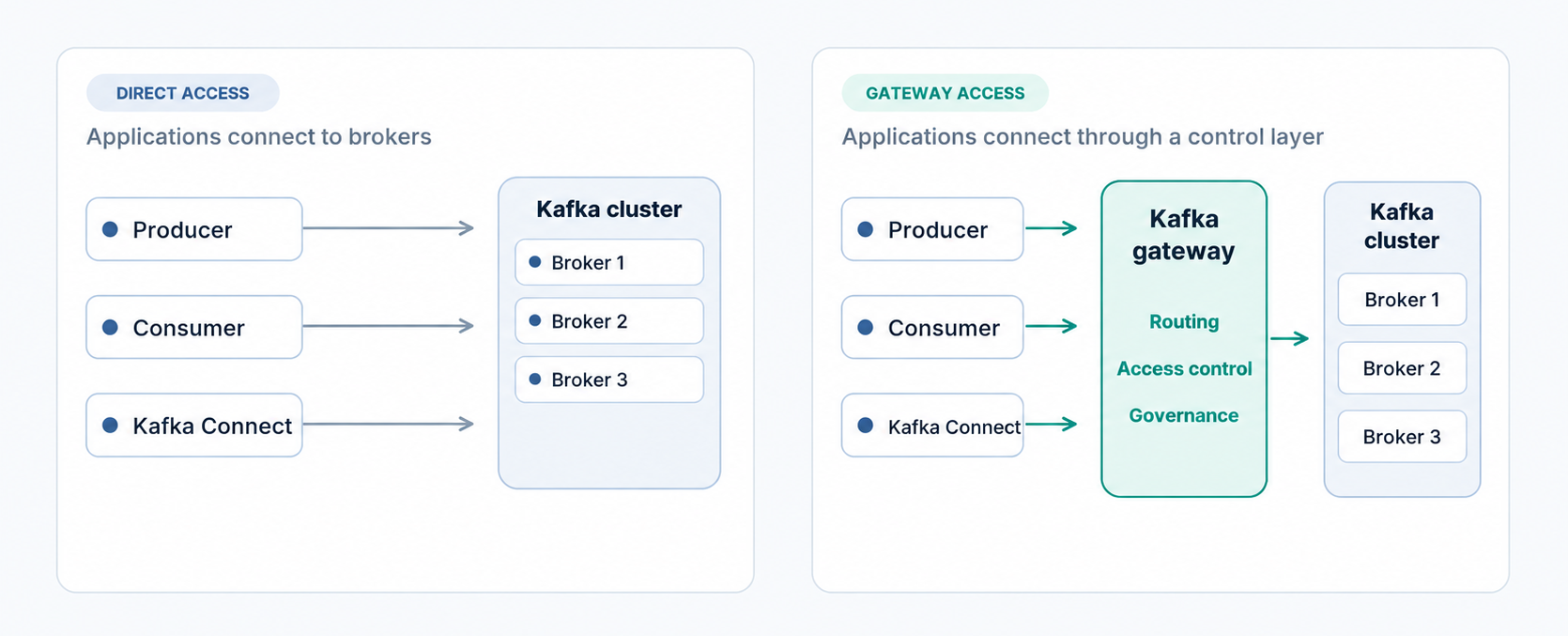
A Kafka gateway is an intermediary between applications and Apache Kafka that manages connectivity, access, traffic, and governance independently of the underlying Kafka brokers.
Rather than connecting directly to a Kafka cluster, clients connect through the gateway. The gateway routes their requests to Kafka and can enforce policies along the way.
Depending on its capabilities, a gateway can authenticate clients, restrict access to topics, inspect records, validate schemas, encrypt sensitive information, or abstract the underlying Kafka infrastructure.
The important distinction is that a Kafka gateway doesn't replace Kafka. It introduces an additional layer of control between applications and the streaming platform.
Kafka proxy vs. Kafka gateway: What's the difference?
The terms are often used interchangeably, but there is a useful distinction.
A Kafka proxy typically refers to a component that intermediates Kafka's native wire protocol. Standard Kafka producers, consumers, and Kafka Connect workers communicate through the proxy using the same Kafka protocol they would use to connect directly to brokers.
A Kafka gateway can encompass that functionality while also supporting additional access patterns, including exposing Kafka data through HTTP, WebSocket, Server-Sent Events (SSE), gRPC, or MQTT.
Not every product supports both.
There is also an important difference between a generic TCP proxy and a Kafka-aware proxy. Kafka clients don't communicate with a single broker endpoint in the same way HTTP clients communicate with a web server.
They discover broker topology, connect to partition leaders, participate in consumer groups, and coordinate transactions. A proxy that understands Kafka's protocol can interpret and, where necessary, modify these interactions. A generic TCP proxy generally cannot.
Understanding these distinctions is important because different gateway architectures solve different problems.
Seven reasons organizations introduce a Kafka gateway
1. Simplifying Kafka connectivity across networks
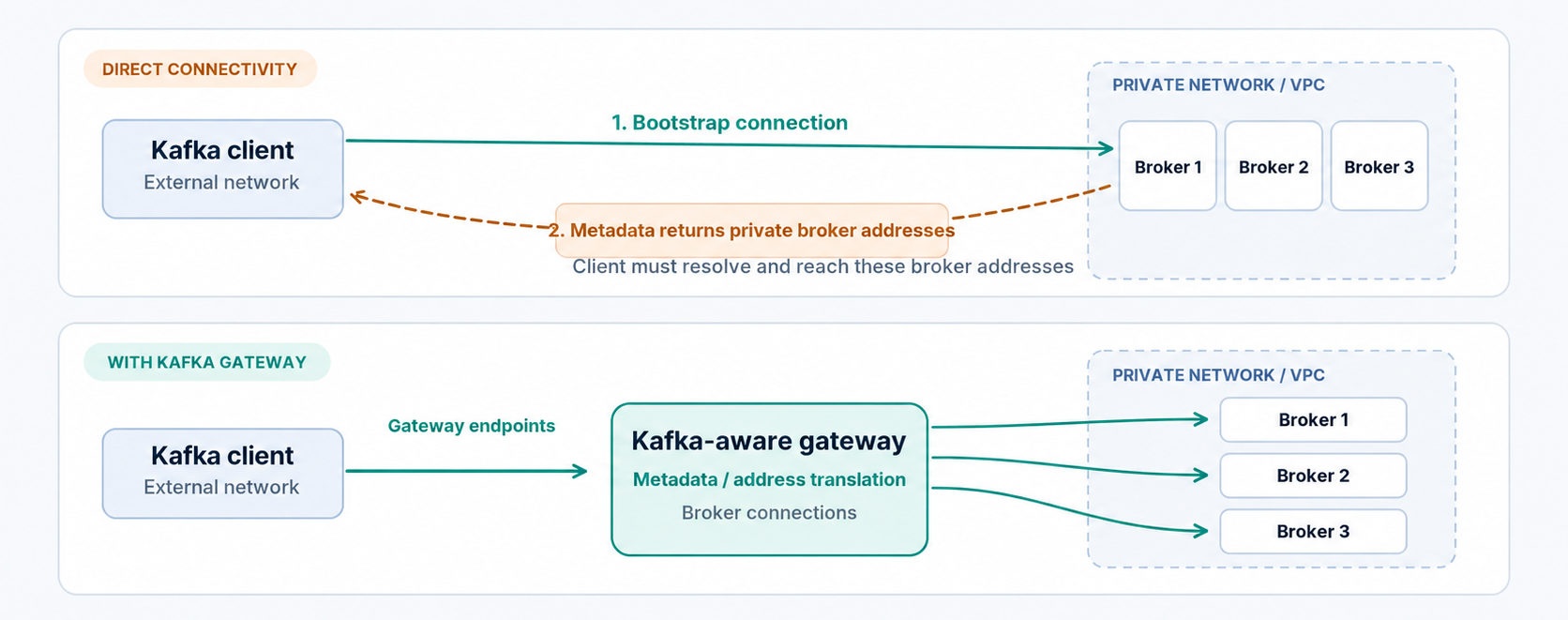
Kafka's networking model creates challenges when clients and brokers reside in different network environments.
A Kafka client initially connects to a bootstrap server and retrieves cluster metadata. That metadata contains addresses of the brokers responsible for the partitions the client needs to access. The client then establishes connections to those brokers.
Consequently, providing access to a Kafka bootstrap endpoint isn't enough. Clients must also be able to resolve and reach the broker addresses returned in metadata.
This can become complicated when Kafka is accessed across:
- Multiple VPCs, cloud accounts, or regions.
- Private networks and on-premises data centers.
- NAT boundaries and firewalls.
- External customers, vendors, and partners.
- Hybrid and multi-cloud environments.
A Kafka-aware gateway can provide stable external endpoints and translate broker addresses so clients can communicate with Kafka without direct access to the cluster's internal network topology.
For example, an organization operating Amazon MSK in a private VPC may need to provide access to applications belonging to another business unit or an external partner. A gateway can establish a controlled access boundary without exposing the underlying brokers directly.
When is a gateway needed? When Kafka's networking requirements create significant connectivity complexity, particularly across organizational or infrastructure boundaries.
What are the alternatives? Private networking, VPNs, PrivateLink-style connectivity, DNS management, and Kafka's native listener configuration can address many of these scenarios. A gateway becomes attractive when these approaches are cumbersome or when centralized access control is also required.
2. Centralizing security and access control
Kafka provides a capable security model. TLS protects connections, SASL authenticates clients, and ACLs determine which principals can access Kafka resources.
For many deployments, that's enough.
However, organizations with multiple Kafka clusters, application teams, and security domains may find themselves maintaining authentication and authorization configurations across numerous environments.
Additional requirements may include authenticating external users through a different identity provider, mapping application identities to broker identities, or enforcing policies that native Kafka ACLs cannot express.
A gateway creates an enforcement boundary independent of the Kafka brokers.
For example, a gateway could authenticate external applications using organizational identity infrastructure, then authorize their requests to specific Kafka resources according to centrally managed policies.
This allows security teams to enforce consistent requirements without relying on every application team or Kafka administrator to implement them independently.
When is a gateway needed? When access requirements extend beyond standard Kafka ACLs or when enforcing consistent policies across clusters and environments becomes operationally difficult.
What are the alternatives? Kafka's native security features and centrally managed authorization systems remain preferable when they provide the required controls without additional infrastructure.
3. Enforcing data quality and protecting sensitive information
Kafka excels at reliably storing and distributing records, but its brokers generally treat message payloads as opaque data.
Kafka ACLs determine which applications can read or write topics. They don't ordinarily determine which fields inside a record each consumer is allowed to see.
Consider a financial services organization publishing customer events containing account identifiers, transaction details, and personally identifiable information.
Different consumers may have legitimate reasons to access the same event stream, but they may not be authorized to see the same information.
A fraud detection application might require additional customer attributes that an analytics application shouldn't receive. A customer support application might need masked account numbers rather than the original values.
Without centralized enforcement, organizations often implement these protections in producers, consumers, stream-processing pipelines, or separate topic projections.
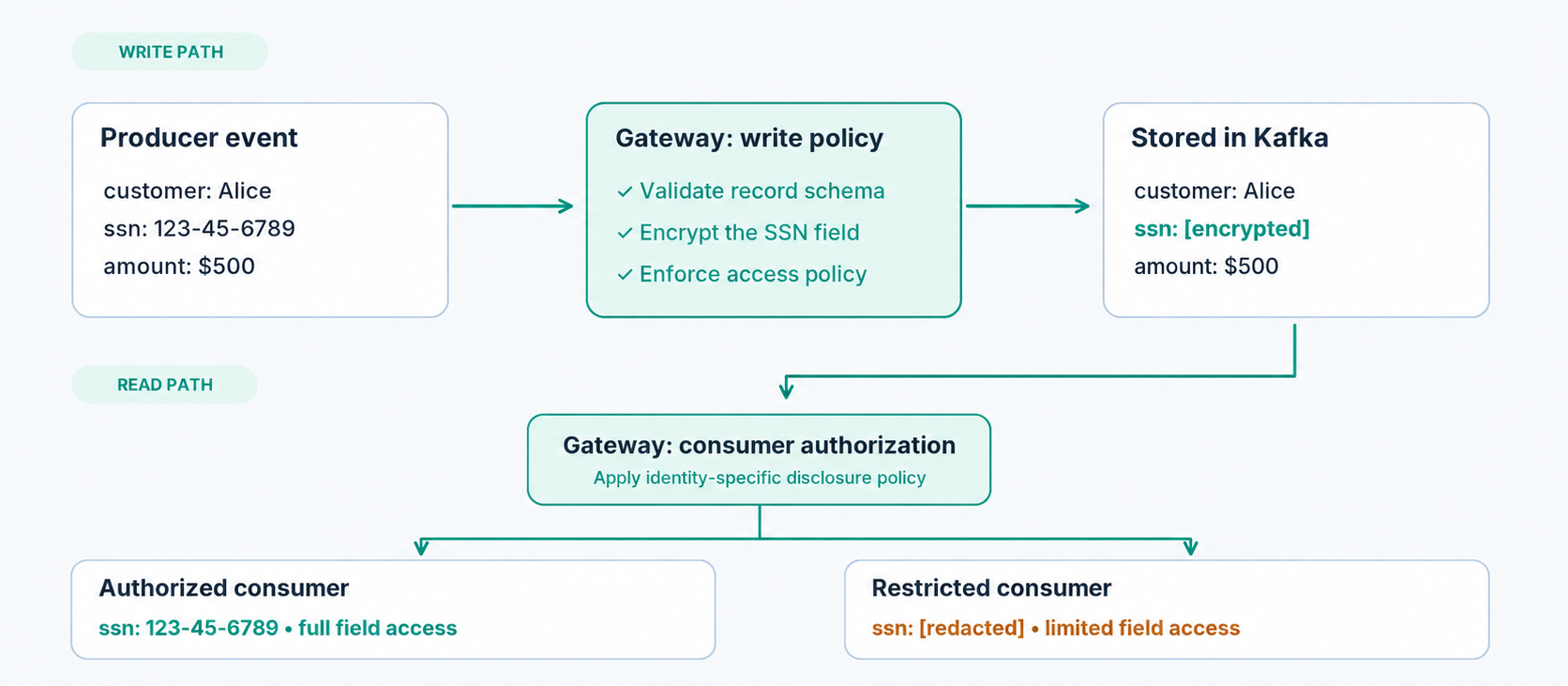
A gateway with record-aware processing capabilities can introduce controls such as:
- Schema validation: Reject malformed or noncompliant records before they reach Kafka.
- Field-level encryption: Encrypt selected fields before storing the events in Kafka.
- Selective disclosure: Decrypt, mask, redact, or omit sensitive fields according to consumer authorization.
- Data transformation: Apply supported format conversions or projections as records pass through.
One especially useful application is protecting data from privileged infrastructure users. If sensitive fields are encrypted before reaching Kafka and the necessary decryption keys remain outside the broker environment, access to Kafka storage doesn't automatically grant access to plaintext data.
This doesn't eliminate the need to trust and secure the gateway itself. It also requires preventing unauthorized paths that bypass the enforcement layer.
When is a gateway needed? When data protection must be applied consistently across applications, particularly when Kafka contains regulated or sensitive information and modifying every producer or consumer is impractical.
What are the alternatives? Schema registries, application-level encryption, Kafka Streams, Apache Flink, and dedicated data-processing services can provide many of these capabilities. A gateway is most valuable when the organization wants enforcement directly in the traffic path.
4. Isolating tenants on shared Kafka infrastructure
Kafka supports multi-tenancy through ACLs, quotas, topic naming conventions, and resource management.
These mechanisms work well for many shared deployments. But more complex requirements emerge when organizations operate Kafka as a service for multiple business units or customers.
Imagine a SaaS provider with hundreds of tenants, each requiring independent Kafka access.
The provider might want every tenant to interact with a topic named orders, while ensuring that each tenant accesses only its own data.
Without an additional abstraction, this often requires tenant-specific topic names, careful client configuration, and extensive access-control management.
A gateway capable of virtualizing Kafka resources can present separate logical namespaces or virtual clusters backed by shared physical infrastructure.
Depending on the implementation, tenant isolation may include topic aliases, distinct authentication policies, quotas, and visibility restrictions.
This can simplify application onboarding while allowing the platform team to manage the underlying infrastructure centrally.
When is a gateway needed? When Kafka serves multiple customers or independent teams that require isolated logical environments, especially when tenant-specific complexity is leaking into applications.
What are the alternatives? Kafka's built-in quotas, ACLs, and topic naming strategies are often sufficient. Virtualization introduces value when additional abstraction or independent tenant management is necessary.
5. Connecting applications that don't speak Kafka
Not every application that needs real-time information should become a native Kafka client.
Browsers, mobile applications, IoT devices, and external partners often communicate through HTTP, WebSocket, SSE, MQTT, or gRPC.
A common solution is to build application services that consume from Kafka and expose the data through these protocols.
That works, but at scale it can produce a growing collection of integration services responsible for similar functions: connecting to Kafka, converting protocols, authenticating clients, managing connections, and delivering events.
A multi-protocol Kafka gateway can consolidate some of this functionality.
For example:
- A browser subscribes to live updates through SSE.
- An IoT device publishes sensor readings over MQTT.
- A partner application produces events using an HTTP API.
- An internal service accesses streaming data over gRPC.
All of these can interact with Kafka through a gateway that maps their protocols to Kafka operations.
This is a different capability from transparent Kafka proxying. Instead of merely forwarding Kafka requests, the gateway mediates between different communication protocols.
When is a gateway needed? When a variety of non-Kafka applications need governed access to real-time data and maintaining separate integration services becomes costly.
What are the alternatives? Kafka Connect, REST proxies, MQTT brokers, and application-specific services are all viable choices. A gateway is particularly useful when protocol mediation, security, and operational controls can be consolidated.
6. Abstracting clusters for migrations and disaster recovery
Kafka infrastructure changes over time.
Organizations migrate from self-managed Kafka to managed cloud services, consolidate deployments, reorganize topics, or change vendors.
These transitions can require updating client endpoints, authentication configurations, and routing rules across many applications.
A gateway can provide stable client-facing endpoints while allowing the underlying cluster connections and routing to change.
For example, applications might continue connecting through the same gateway endpoints while a platform team redirects traffic from an existing Kafka deployment to a new one.
However, routing requests to another cluster is not the same as migrating Kafka state.
A successful migration or disaster recovery strategy may still require topic replication, consumer offset synchronization, transactional considerations, data consistency checks, and coordinated cutover procedures.
A gateway can simplify the client connectivity portion of the process. It doesn't automatically solve the entire migration problem.
When is a gateway needed? When changes to Kafka infrastructure would otherwise require coordinating configuration updates across a large number of applications.
What are the alternatives? Kafka migration tools, MirrorMaker 2, cluster replication, and coordinated client configuration changes may be sufficient.
7. Applying operational guardrails consistently
Kafka exposes broker metrics and provides native quotas to protect resources from excessive client activity.
However, platform teams may also need policies that depend on application identity, topic classification, or organizational standards.
Examples include enforcing topic naming conventions, restricting certain client operations, limiting request sizes, or recording access decisions at a common entry point.
A Kafka-aware gateway can provide another enforcement location for such controls, depending on the features supported by the implementation.
It can also offer a consistent view of client activity across multiple clusters, even when applications and brokers are operated by different teams.
When is a gateway needed? When organizations require consistent operational policies that native broker configuration cannot express or that would otherwise need to be duplicated across applications.
What are the alternatives? Kafka's native quotas and broker configuration, infrastructure automation, and existing monitoring systems should be evaluated first.
How is a Kafka gateway different from an API gateway or service mesh?
Kafka gateways share some architectural goals with conventional API gateways and service meshes, but they operate on different communication models.
Traditional API gateways focus primarily on HTTP-based APIs. They authenticate requests, enforce policies, route traffic, and manage access to application services.
Service meshes provide networking, security, and observability capabilities for service-to-service communication. They can transport Kafka connections, but generic transport-level routing doesn't provide visibility into Kafka topics, partitions, or consumer groups.
A Kafka-aware gateway operates at the Kafka protocol level.
This matters because Kafka isn't simply a stream of independent requests. Its clients interact with brokers through metadata discovery, partition assignments, offset management, consumer group coordination, and transactional operations.
A gateway that transparently proxies Kafka traffic must preserve the relevant protocol behavior, not merely forward packets.
Some API gateway and proxy technologies now support Kafka-specific functionality, so these categories are not mutually exclusive. The important consideration is the depth of Kafka protocol support rather than the product label.
Similarly, AsyncAPI can document Kafka-based event interfaces, but documentation and runtime enforcement solve different problems. A specification describes an interface; a gateway can enforce policies when that interface is used.
What are the trade-offs of adding a Kafka gateway?
Introducing a gateway is not automatically an improvement.
It places another software component in the path between applications and Kafka. That component must be deployed, operated, secured, and scaled.
There are several important trade-offs to consider.
Performance overhead. Additional network hops and processing can increase latency and infrastructure costs. The actual impact depends on architecture, deployment location, record processing requirements, and implementation efficiency.
Availability. A gateway introduces another potential failure point. Production deployments need redundancy, health checks, and capacity planning to avoid creating bottlenecks or availability problems.
Protocol compatibility. Transparent proxies must support the Kafka protocol behaviors used by their clients. Compatibility with consumer groups, transactions, idempotent producers, Kafka Connect, and different client versions should be verified rather than assumed.
Operational complexity. Centralized controls simplify some tasks but create another system to configure, monitor, upgrade, and troubleshoot.
Security exposure. A gateway capable of decrypting or modifying Kafka records occupies a privileged position. Its own security controls, key management, and operational access require careful design.
Centralized failure impact. Consolidating policy enforcement can increase the blast radius of a configuration error. A mistake that previously affected one application might now affect many.
A gateway should therefore be evaluated on its incremental value, not simply its feature list.
Keep business logic out of the gateway
Another important architectural consideration is the boundary between infrastructure enforcement and application processing.
Routing, authentication, schema validation, and certain forms of data protection are generally good candidates for a gateway.
Stateful business transformations, joins across streams, and complex event processing are usually better implemented in tools designed for that purpose, such as Kafka Streams or Apache Flink.
The goal isn't to make a Kafka gateway responsible for everything that happens to an event. It's to centralize the cross-cutting controls that are otherwise difficult to apply consistently.
When do you actually need a Kafka gateway?
The decision usually becomes clearer when viewed through a few practical questions.
No single answer necessarily justifies introducing a gateway.
An organization with a small, well-controlled Kafka deployment may be better served by native Kafka capabilities and established infrastructure tooling.
An enterprise operating Kafka across cloud environments, serving external clients, handling sensitive data, and supporting numerous independent teams may find the economics very different.
In that environment, centralizing access and governance may reduce the cost and risk of repeatedly implementing similar controls across applications and infrastructure.
What should you look for in a Kafka gateway?
If a gateway is justified, its implementation matters.
For native Kafka proxying, look for comprehensive protocol compatibility and the ability to maintain Kafka client behavior without custom SDKs or application rewrites.
Consider whether the gateway supports the authentication and authorization methods already in use, and whether policies can be managed declaratively and consistently.
Performance should be evaluated under realistic workloads. Simple pass-through traffic, schema validation, and field-level encryption have different resource and latency characteristics.
A gateway should also scale independently of Kafka and avoid introducing unnecessary shared state or coordination. Not every function is stateless, but the data path should be kept as simple as the requirements permit.
Finally, consider whether the architecture helps reduce operational complexity or simply relocates it. A gateway that requires extensive custom code or separate infrastructure for every policy may undermine the very benefits it is meant to provide.
The bottom line
Kafka gateways aren't a requirement for every Kafka deployment, nor should they be.
Apache Kafka provides powerful native capabilities, and introducing an additional component into the data path comes with real trade-offs. But as Kafka evolves from an internal event-streaming system into a broadly consumed enterprise data platform, requirements around connectivity, security, governance, and access become more complex.
A gateway can provide a useful architectural boundary for addressing these requirements without distributing the same responsibilities across every application or modifying the Kafka infrastructure itself.
So the question isn't whether Kafka needs a gateway, but rather it's whether managing connectivity and governance separately from Kafka, through a shared enforcement layer, provides more value than the complexity that layer introduces. For some organizations, the answer is no, while for others, particularly those operating Kafka across multiple networks, security domains, and applications, the answer can be compelling.
Related Resources
Ready to Get Started?
Get started on your own or request a demo with one of our data management experts.

Explore pricing
Straightforward, usage-based pricing with no per-connection surprises — start free and scale when you are ready.


Join the Community
Trade notes with the engineers running Zilla in production, and get help from the team in Slack or Discord.