Introducing Zilla 2.0: The Gateway for Real-Time Data and AI
Zilla is expanding beyond Kafka to connect and govern AI agents, beginning with native support for the Model Context Protocol.



Aklivity was founded to help enterprises tame real-time data.
We built Zilla as a Kafka-native gateway so platform teams could make streaming data easier to access, govern, and reuse. It gave applications, services, devices, partners, and developers a secure way to reach Kafka using the protocols they already understood.
Today, a new kind of client is emerging: the AI agent.
Agents need access to data, tools, applications, models, and other agents. They make decisions dynamically, cross system boundaries, and act on behalf of people and organizations. Enterprises need a consistent way to control what agents can access, which actions they can take, and how those actions are observed and audited. The client may have changed, but the underlying problem has not.
Today, we are announcing Zilla 2.0. Zilla is evolving from a Kafka-native gateway into a unified gateway for real-time data and AI, beginning with native support for the Model Context Protocol.
Our mission is to help enterprises turn real-time data and AI into trusted, scalable business capabilities.
The architecture was already there
Kafka sits at the center of many enterprise real-time systems, but everything around it communicates differently. Connecting applications, APIs, devices, partners, and internal services often requires layers of custom middleware.
Zilla replaced those wrappers with a declarative, streaming-native gateway. HTTP, SSE, WebSocket, gRPC, MQTT, and Kafka are represented through a common streaming model. Security, schemas, routing, and observability are composed into the same runtime using reusable guards, vaults, catalogs, models, and exporters.
The architecture is designed for sustained streaming traffic, long-lived connections, backpressure, and low-latency protocol mediation, with benchmarked overhead measured in only a few milliseconds at p99.
MCP did not require a separate gateway or an AI proxy bolted onto Zilla. It merely required a new native protocol binding on the runtime that was already there.
The agent is a new kind of client
Enterprise AI is not only a model problem. It is also a connectivity and governance problem.
An agent calls tools, retrieves data, invokes APIs, writes to systems of record, produces events, and may delegate work to another agent. One prompt can cross several protocols and systems.
Enterprises need to know which agent is making a request, who it represents, which tools it may discover, what data it can access, and which actions it can perform.
Building those controls independently into every agent or MCP server will not scale. The gateway provides a consistent enforcement point where identity can be verified, access authorized, schemas validated, credentials protected, and interactions observed.
This is the same role Zilla already plays for applications connecting to Kafka. Zilla 2.0 now brings that model to agents connecting through MCP.
Another MCP gateway? Not exactly.
Many products can place one endpoint in front of several MCP servers. Zilla can do that too.
But most enterprises do not yet have an MCP server for every internal API, data source, and Kafka topic. They have REST services, OpenAPI specifications, schemas, event streams, and operational systems. Turning all of them into MCP capabilities would normally require another generation of wrappers.
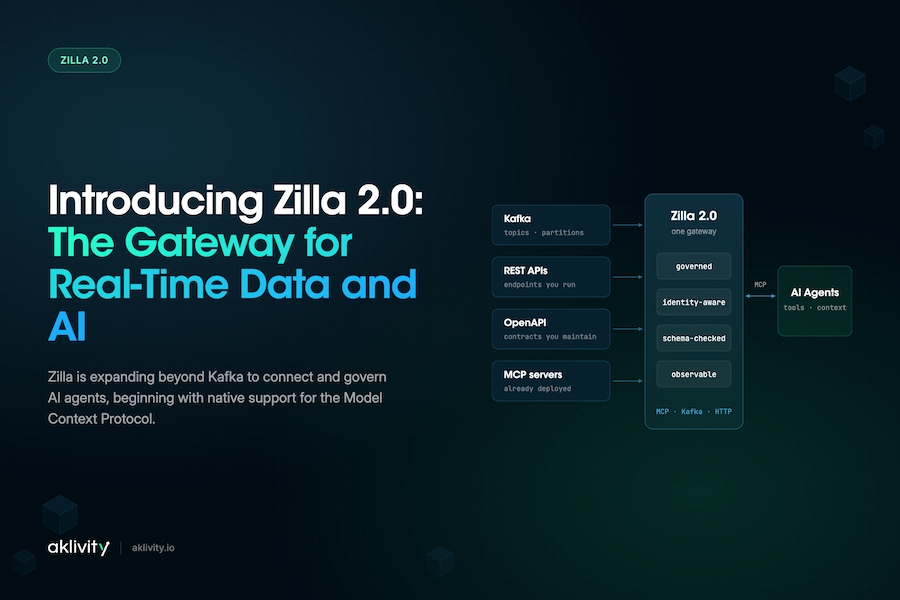
Zilla takes a different approach. MCP is implemented as a native Zilla stream type alongside HTTP and Kafka. With Zilla 2.0, teams can:
- Aggregate existing MCP servers behind one endpoint.
- Turn REST APIs and OpenAPI contracts into MCP tools and resources.
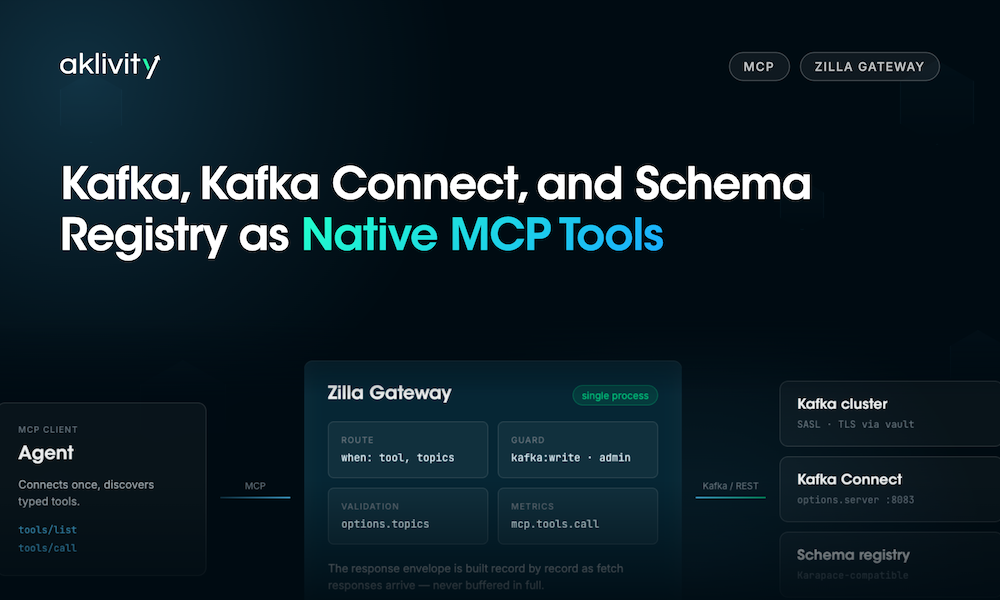
- Expose Kafka through MCP without a custom wrapper.
- Control which tools each caller can discover and invoke.
- Keep common tools available while making larger catalogs searchable.
- Validate schema-governed payloads and observe MCP traffic.
Most MCP gateways govern access to tools that already exist. Zilla can also turn the APIs, schemas, and real-time data enterprises already have into governed MCP capabilities.
Connecting agents to what is happening now
Many AI systems begin with documents and static knowledge. But high-value enterprise use cases often depend on current operational state.
An inventory agent needs current availability. A fraud agent needs the latest transaction signals. A manufacturing agent needs live telemetry. A customer-service agent needs to know what just happened to an order.
That information increasingly moves through Kafka.
Kafka gives agents a continuous, ordered, and replayable record of what is happening across the business. MCP gives them a standard way to discover and use capabilities. Zilla connects the two while preserving identity, policy, schema, and audit controls.
Kafka gives agents a live view of the business, MCP gives them a standard way to act on it, and Zilla connects the two.
What comes next
Zilla Plus will build on the open-source MCP foundation with semantic tool discovery, adaptive context management, and cross-node session routing for horizontally scaled deployments.
Zilla will also expand beyond MCP.
The planned LLM gateway will bring provider-aware routing, credential injection, identity propagation, token quotas, telemetry, and failover to model traffic.
The planned A2A gateway will govern synchronous, asynchronous, and streaming communication between agents. It will also allow Kafka-backed agents to participate in the Agent2Agent ecosystem without operating their own A2A servers.
MCP governs how agents reach tools. LLM gateway capabilities govern how applications reach models. A2A governs how agents reach one another.
Zilla will bring all three onto the same streaming-native, multi-protocol gateway runtime.
A new community for Zilla’s next chapter
We have also launched an Aklivity Discord server for developers building with MCP, agents, Kafka, and Zilla. It will be the home for AI architecture discussions, examples, experiments, office hours, and community projects.
Slack will remain focused on production deployments, Kafka gateway use cases, contributors, partners, and established Zilla practitioners.
We’re also launching Aklivity Open, a biweekly community office hour covering AI, agents, gateways, and real-time data. Join us for informal 30-minute sessions where we’ll answer questions, share insights, run demos, and provide the latest product updates. First one is coming up this Thursday, August 6, 2026 at 9AM PDT →.
Try Zilla 2.0
The Zilla MCP Gateway quickstart runs locally using Docker Compose. It brings up one Zilla endpoint in front of an MCP server, an OpenAPI-described REST service, and a Kafka broker exposed through native produce and consume tools.
Connect using Claude Code or another MCP client, control tool visibility with JWT scopes, and produce and consume Kafka messages through MCP.
⌨️ Try the Zilla MCP Gateway →
💬 Join the Aklivity Discord Server →
Until now, Zilla has governed how applications, services, devices, and people connect to real-time data. Now it will do the same for agents.
One gateway for real-time data and AI.
Ready to Get Started?
Get started on your own or request a demo with one of our data management experts.

Explore pricing
Straightforward, usage-based pricing with no per-connection surprises — start free and scale when you are ready.


Join the Community
Trade notes with the engineers running Zilla in production, and get help from the team in Slack or Discord.